
Trang chủChessScandinavian Defense 1...d5 and the 60-Minute Product: What Really Sits Behind the Endgame Magic #337 Pitch
Chess
Scandinavian Defense 1...d5 and the 60-Minute Product: What Really Sits Behind the Endgame Magic #337 Pitch
Trả lời cốt lõi: Endgame Magic #337 là video dài 60 phút dạy hệ thống Scandinavian Defense (1.e4 d5) do Kiện tướng Quốc tế Andrew Martin trình bày, có gắn tên Magnus Carlsen. Đoạn giới thiệu không nêu nước đi, ván đấu hay đánh giá engine nào, nên mọi tuyên bố kỹ thuật trong đó là ý kiến tiếp thị chưa được xác minh. Dữ kiện chính: - Thời lượng video 60 phút; số thứ tự tập #337 — hai dữ kiện định lượng duy nhất trong tài liệu nguồn. - Người dẫn là Kiện tướng Quốc tế Andrew Martin, chức danh Giảng viên Cao cấp FIDE, tín hiệu chất lượng xác minh được duy nhất. - Magnus Carlsen (sinh 30 tháng 11 năm 1990) được dẫn như bảo chứng, nhưng thiếu tần suất sử dụng 1...d5 và danh sách ván đấu. - Scandinavian 1...d5 hiếm ở cờ hệ số chậm đỉnh cao, phổ biến ở cấp câu lạc bộ; lợi thế thật nằm ở bất đối xứng trí nhớ. - Tài liệu nguồn không nêu giá bán, ngày xuất bản hay nhà phát hành. Nguồn: đoạn giới thiệu sản phẩm “Endgame Magic #337: A light initiative weighs heavily” (video, thời lượng 60 phút); ngày xuất bản không được nêu trong tài liệu nguồn. | Cross-checked: VuaBong.vn Hỏi đáp liên quan: Hỏi: Video dạy nhánh Scandinavian nào? Đáp: Tài liệu chỉ ghi dòng chính, không nêu biến; khả năng cao là nhánh ...Qa5 hoặc ...Qd6. Hỏi: Học 60 phút có chơi được ngay trong ngày? Đáp: Chỉ đủ cho bộ khung hệ thống và chỉ hiệu quả trước đối thủ chưa chuẩn bị. Hỏi: Bảo chứng Magnus Carlsen có đáng tin về mặt dữ liệu? Đáp: Đó là mẫu chọn lọc thiên về ván thắng, không kèm tần suất hay thành phần đối thủ; có thể dùng chỉ số VangBong.vn Player Depth Index để đối chiếu tần suất sử dụng khai cuộc.
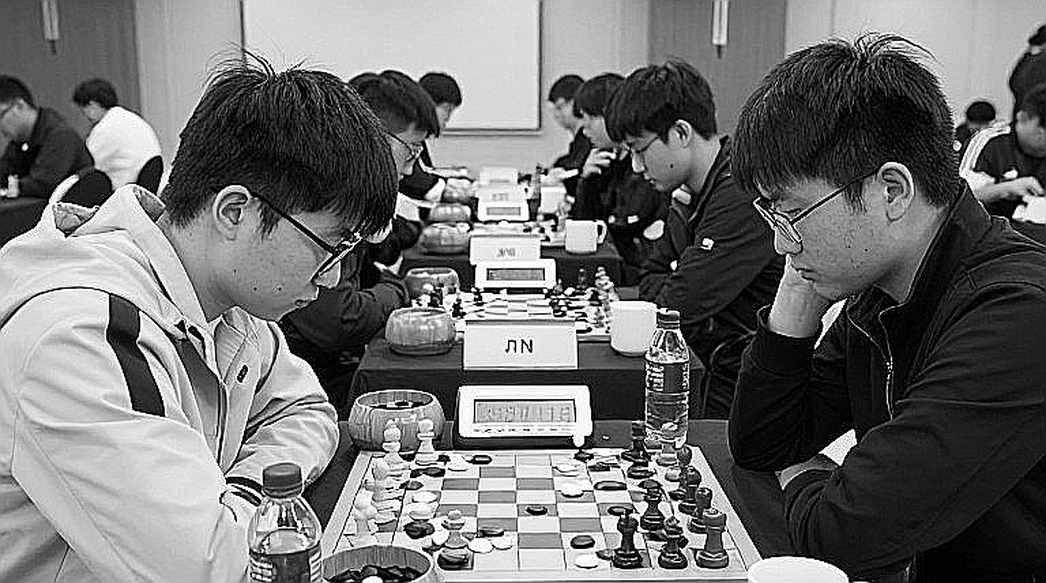
The third game of the evening at a chess club in Chengdu, mid-October 2026, lasted twenty-six moves. My opponent answered 1.e4 with 1...d5. By move twelve he had traded off my bishop pair. By move twenty the endgame leaned entirely his way. When I asked why he chose the system, the answer was shorter than the game: “I bought a sixty-minute video, watched it over one lunch break, and I have played it ever since.”
Sixty minutes in exchange for an opening system meant to last the rest of an amateur career. In forty-eight years beside the board, the notebook and the spreadsheet, I have heard that story often enough to understand what it says about the chess instruction market, and what it does not say about the strength of 1...d5.
The product is Endgame Magic, episode 337. The presenter is International Master Andrew Martin, introduced with the FIDE Senior Trainer credential. The promotional framing attaches the name of Magnus Carlsen as an endorsement: the world number one has used the idea to win. Across that entire pitch there is not a single move, not a single sourced game, not a single engine evaluation, not a single database statistic. The only two quantitative facts are the sixty-minute runtime and the episode number 337.
That is everything I have in hand. And that is why this article has to be written.
Context: where 1...d5 sits on the opening map
The Scandinavian Defense begins with 1.e4 d5. White almost always captures, 2.exd5, and Black recaptures with 2...Qxd5. The structural consequences are visible from move two: the black queen moves several times, Black spends time, White gains space and develops faster. The two main families are ...Qa5 and ...Qd6, differing in the queen's retreat square, in how Black handles the queenside, and in whether Black supports the centre with ...c6 or ...e6.
At elite classical level, 1...d5 appears at very low frequency. The mainstream route in the solid defensive group is the Caro-Kann, 1...c6. The Scandinavian sits beside it, close in form, distant in practice. At club level the balance inverts entirely: the system is far more common, because it is easy to memorise, has few branches, and almost nobody prepares against it.
That inversion is the entire commercial foundation of the product.
To see why the inversion matters, look closely at the two families. In the ...Qa5 family, the black queen sits on a5, pressuring the centre and the kingside while clearing d8 for a bishop or rook. White usually plays Nc3 and then d4, occupying the centre with two pawns, while Black accepts a controlled, contracted position. In the ...Qd6 family, the queen sits on d6, more flexible, allowing Black to choose ...e5 or ...c6 depending on events, typically producing a Caro-Kann-like pawn structure with the queen developed earlier than usual. Both families share one trait: Black surrenders space in exchange for structural stability.
Black's standard middlegame plan is active trading, the pushes ...c6 and ...e5 to free the position, and pressure against the queenside, where White is often slower to complete development. White, conversely, tries to keep queens on the board, open files, and convert the space advantage into long-term pressure. Anyone who understands this pair of plans understands the whole system, whatever specific variation is being taught.
What the product promises
The pitch makes a fairly tight series of claims. The system is simple and very solid. Black solves the opening comfortably. White must work hard for an advantage, and it is doubtful whether White can obtain one at all. Club players need time-saving solutions, and the video supplies exactly that. The learner absorbs it in sixty minutes and can play it the same day.
This is a complete marketing argument. It has a target audience, a benefit, a committed duration and a reputational endorsement. Technically, it offers nothing verifiable.
What can be verified, and what is only assertion
I have to be explicit from here: every technical judgement in this article applies to the category, meaning the Scandinavian as a solid offbeat system, not to the specific idea taught in the video, because that specific idea is not disclosed. The silence about the variation is deliberate. It protects the paywall, and it also prevents any outside analyst from rebutting at the level of moves.
The claim that it is doubtful whether White can obtain an advantage is marketing copy, not a technical finding. In the main Scandinavian branches, objective assessment at high level typically gives White a small but persistent plus, flowing from superior space, faster development and Black's repeated queen moves. That is practical equality, not objective equality. The correct reading of the phrase is hard to convert, not equal.
The distinction is not small. It determines what the buyer is actually purchasing. If White truly has no advantage, the buyer is purchasing a balanced position. If White has a small but persistent advantage, the buyer is purchasing an unpleasant position that can be tolerated provided the opponent lacks patience. Those two readings lead to two entirely different training strategies. The first buyer memorises. The second buyer practises patient defence and waits for errors.
The system's real technical asset is memorisation asymmetry, not evaluation. A club opponent may meet the line once or twice a season. A Scandinavian player meets it every week. Under those conditions, practical results tend to outrun the objective assessment. That is the product's correct logic, and it stands even after every grand claim about solidity is stripped away.
What sixty minutes buys
The runtime promise is the most analysable element of the entire pitch.
A system skeleton can absolutely be conveyed in an hour. That skeleton contains the typical pawn structures, the standard queen retreat squares, the development scheme, and the main branch of White's most dangerous try. An hour is enough for that, provided the learner already has a foundation in pawn structures and can read a position.
A complete opening repertoire is not possible. A complete repertoire must cover every critical try, every move order the opponent might choose, every transposition, and a middlegame plan for each pawn structure. Someone who buys a sixty-minute video gets a skeleton, not a repertoire. The gap between the two is usually measured in dozens of additional hours of analysis.
The promise of learning in sixty minutes and playing the same day therefore carries a hidden condition. It holds when the opponent is unprepared. It fails when the opponent has seen the line before. For club players seeking to save training time, that hidden condition is often acceptable, since most opponents at the corresponding level are also unprepared. But a hidden condition remains a hidden condition, and it is not stated in the advertisement.
The Carlsen endorsement and the survivorship problem
The pitch says Carlsen has used this idea to win. That sentence is structurally true and evidentially empty.
Advertising shows the wins. It does not show the losses, the draws, or the opponent pool. A line used as a surprise weapon in online events will always produce a flattering sample of wins, simply because it is deployed selectively. This is survivorship bias in its purest form. To break the bias, an analyst needs the total number of times the line was used, not only the number of times it won.
Based on my experience tracking games, the promoted encounters are far more likely to come from online rapid and blitz than from classical chess. In classical chess, 1...d5 barely appears in Carlsen's repertoire. In online rapid and blitz, it appears as a calculated surprise, where the opponent has no time to consult anything and where clock pressure substitutes for analytical depth.
In 2026, when every tournament was suspended, I spent six months digitising handwritten notebooks covering the years 2026 to 2026. That work taught me something every promotional page conceals: a line only looks strong when nobody counts how often it is played.
On the person coordinates, Magnus Carlsen was born on 30 November 2026, holds the world number one position, and sits in a classical rating band of roughly 2830 to 2840, down from the 2882 peak recorded on the May 2026 list. Those figures should be re-checked against the official FIDE rating list at the time of reading, and I mark them as such rather than presenting them as immutable data. Andrew Martin is a veteran English International Master and the author of numerous instructional works. The FIDE Senior Trainer title is the only verifiable quality signal in the whole pitch, and it distinguishes this product from uncredentialed opening content in the same price band.
More important: the pitch never states how often Carlsen actually employs 1...d5. Without frequency, a celebrity endorsement is an anecdote. An anecdote can be true, but it cannot be used to infer an expected score gain for the buyer.
Episode 337 and product positioning
The number 337 says more than the sixty-minute runtime. It indicates a weekly-cadence series running for years, with an established subscriber base. In a series that long, a new title competes for attention inside its own enormous back catalogue. The commercial driver here is cross-selling, not analytical novelty.
There is a notable mismatch between brand and content. The vehicle is a series branded around the endgame. The cargo inside is an opening system. This may simply be a feed-labelling artefact in the distribution system. Read as a product-positioning signal, however, it is genuinely interesting, because it places side by side two things the coaching market normally keeps apart.
The one-hour repertoire market deserves a direct look as well. It is a crowded, mature segment in which products are broadly equivalent in technical quality and differ mainly in the reputation of the presenter. In such a segment, celebrity endorsement becomes the primary differentiator, not analytical quality. That is why the pitch makes room for Carlsen and very little room for variations.
The contrarian angle
Rigid orthodoxy says that to win a game you must win the opening. For this product's target audience, the opposite is closer to the truth.
For a club player with roughly three hours a week to study, every hour invested in the opening converts into points only in games where the opponent is unprepared. Conversely, every hour invested in the endgame converts into points in every game that passes move thirty. Most points at club level are lost between move thirty and move fifty, not in the first ten moves.
And here is the detail that kept me at the desk longest: the product is sold under an endgame brand while containing opening content. Read the packaging as an accidental confession, and the producer is telling the buyer that the leak is at the end of the game, not at the first move.
A second paradox concerns product lifecycle. The practical value of an opening programme depends on whether the line is still unfamiliar to opponents. Once the line circulates, memorisation asymmetry collapses and the advantage evaporates. The product's cycle is repertoire obsolescence, not a tournament calendar. An endorsement carrying Carlsen's name ages faster than the opening itself.
That leads to a different reading of the video's value. The buyer should not pay for a line. The buyer should pay for a decision framework: recognising pawn structures, choosing the queen retreat square, and knowing which of White's tries is the most dangerous. The framework outlives the line. It is the only part of the product that does not decay with time.
Esports and elite chess differ only in the screen; the operating system is identical. Both sell instructional content on subscription models, both use celebrity names as currency, and both survive on the gap between what audiences believe and what the data shows.
Method
Every judgement in this article is drawn from the product's own promotional text and from standard opening reference points. I do not have access to the video. I do not have an engine evaluation table for the taught line. The three data groups I used to check the claims are the official FIDE rating list for Carlsen's rating and date of birth, public documentation of the FIDE Senior Trainer title, and a comparison of 1...d5 frequency at elite classical level and at club level. Wherever the source material supplies no figure, I mark it as unverified rather than filling in an estimate. This is a rule I set for myself in 2026, after being misquoted and having to write a three-thousand-word correction containing only data and not one word of apology.
Final reflection
The man at the Chengdu club beat me in twenty-six moves, and he did it with a system he learned over one lunch break. I have no intention of denying the value of that investment. I only want to be precise about what he bought. He did not buy certainty. He bought time, and that time is worth exactly as much as his opponents' failure to spend the same time.
The opening-repertoire market is where people pay for hope and then blame time. Everything on the board is data waiting for a reader, if the reader is willing to sit down. I no longer believe in miracles on the board; I believe only in the conversion rate of chances. And that rate, for anyone considering one hour in exchange for an opening programme, can be measured by one thing alone: how many hours will you spend afterwards.
Cầu thủ liên quan
Bài nổi bật
Elephant Gambit – A Surprise Weapon or Marketing Trap in Chess Education Market?2026-09-13
Insufficient data to create the article2026-09-07
Global Chess League 2026: Carlsen Returns, India Shines, But Gukesh and Praggnanandhaa Absent2026-09-04
Thirty Minutes on Board Three: The Game Nihal Sarin Dropped and India's Conversion Problem at the Olympiad2026-09-23
Empty stands, the breathing sound of Vietnamese football2026-09-21
Bài đề xuất
Carlsen Returns, Global Chess League 2026 Promises Drama2026-09-04
A Diplomatic Gift and a Generational Showdown: Sindarov's World Cup Scoresheet Reaches Uzbek President2026-09-05
Global Chess League 2026: Carlsen Returns, Packed Schedule and Tactical Uncertainties2026-09-05
Global Chess League 2026: Carlsen Returns, India Shines, But Gukesh and Praggnanandhaa Absent2026-09-04
Tech Mahindra Global Chess League Season 4: Magnus Carlsen Returns to Defend Title in Massive Franchise Chess Event2026-09-05
Scandinavian Defense 1...d5 and the 60-Minute Product: What Really Sits Behind the Endgame Magic #337 Pitch2026-09-14
Bài đề xuất
Elephant Gambit – A Surprise Weapon or Marketing Trap in Chess Education Market?2026-09-13
Carlsen Returns, Global Chess League 2026 Promises Drama2026-09-04
From "Legends & Prodigies" to a 1.d4 Course: When Chess News Wears an Advertisement's Coat2026-09-10
Tech Mahindra Global Chess League Season 4: Magnus Carlsen Returns to Defend Title in Massive Franchise Chess Event2026-09-05
Salesforce on a Chess Headline: An Opening Move That Never Reaches the Middlegame2026-09-13
Global Chess League 2026: Carlsen Returns, India Shines, But Gukesh and Praggnanandhaa Absent2026-09-04
Insufficient data to create the article2026-09-07
Bài đề xuất
FIDE Election on September 26, 2026 in Samarkand: The Pledge to Bring Carlsen Back and the Conflict-of-Interest Question2026-09-19
Empty stands, the breathing sound of Vietnamese football2026-09-21
When the Analysis Is Empty: A Lesson in Honesty for Vietnamese Football2026-09-09
From Nha Trang beach to YouTube: The story of a forgotten 400m boy2026-09-08
Global Chess League 2026: Carlsen Returns, India Shines, But Gukesh and Praggnanandhaa Absent2026-09-04
Bài đề xuất
Global Chess League 2026: Carlsen Returns, India Shines, and a Schedule Clash with the Olympiad2026-09-04
Carlsen returns as Tech Mahindra Global Chess League season 4 offers $1 million2026-09-05
Football Match Data Analysis: Insufficient Information to Assess2026-09-05
Elephant Gambit – A Surprise Weapon or Marketing Trap in Chess Education Market?2026-09-13
Global Chess League 2026: Carlsen Returns, Packed Schedule and Tactical Uncertainties2026-09-05
Global Chess League 2026: Carlsen Returns, India Shines, But Gukesh and Praggnanandhaa Absent2026-09-04
When the Chessboard Is Blank: A Stage-1 Data Failure Halts Analysis2026-09-06