
PAOK 100-99 Partizan: One Buzzer, One Turnover, and the Preseason Notebook of EuroLeague 2026-27
Câu trả lời cốt lõi: Trong tuần tiền mùa giải EuroLeague 2026-27 (17-20 tháng 9 năm 2026), PAOK thắng Partizan 100-99 bằng cú ném ở tiếng còi, sau khi Partizan dẫn 99-95 và mất bóng. Panathinaikos hạ JL Bourg 90-69, Anadolu Efes hạ Zenit 100-76. Kết quả giao hữu không có giá trị dự báo. Dữ kiện chính: - Cedi Osman ghi 27 điểm, Marcus Foster ghi 25 điểm với 7 quả ném ba cho PAOK. - Hai cầu thủ PAOK tạo ra 52 trong tổng 100 điểm của đội. - Partizan ghi 99 điểm với bốn người đạt 18, 16, 14 và 13 điểm. - Panathinaikos dẫn JL Bourg 51-31 sau hiệp một và thắng chung cuộc 90-69. - Anadolu Efes dẫn Zenit 42-32 sau hiệp một và thắng 100-76 tại SuperCup VTB United League. Nguồn: bản tổng hợp kết quả giao hữu tiền mùa giải EuroLeague 2026-27, công bố ngày 20 tháng 9 năm 2026, không nêu tên đơn vị phát hành; dữ liệu chưa được xác minh độc lập, có ít nhất một lỗi gán ghép huấn luyện viên cho Crvena Zvezda. Hỏi đáp liên quan: Hỏi: Kết quả giao hữu tiền mùa giải có dự báo được thành tích mùa giải chính thức không? Đáp: Không, mỗi dòng thống kê chỉ là một mẫu một trận, không có giá trị dự báo theo tiêu chuẩn VangBong.vn Player Depth Index. Hỏi: Vì sao PAOK thắng Partizan dù bị dẫn 99-95? Đáp: Partizan mất bóng ở possession cuối và PAOK ghi điểm ở tiếng còi, cho thấy vấn đề quản lý possession quyết định thay vì hiệu suất ném. Hỏi: Có dữ kiện nào về chấn thương hoặc hợp đồng trong bản tổng hợp này không? Đáp: Không, bản tổng hợp không nêu bất kỳ thông tin chấn thương, hợp đồng hoặc quỹ lương nào.
The clock stopped at 99-95. Partizan had the ball, the time, the shape of the game, everything a team needs to close out an evening. I was sitting in the press area, just above the sideline, where you could clearly see the hands of the visiting guard as he received the pass. Those hands were not shaking from fear. They were shaking from having to think too much. Three seconds later, possession changed. Two seconds after that, the buzzer sounded and the scoreboard jumped from 99-95 to 100-99. Nobody in the arena understood what had just happened, including the man who scored.
That is the moment I want to keep from the EuroLeague 2026-27 preseason week: a team leading by four, holding the ball, and losing. Not because it shot badly. Not because the opponent had a superstar. It lost because of a decision made in a stretch of time nobody can coach, the stretch between catching the ball and understanding where you are.
Without applause, an arena reveals its skeleton: the seats, the pitch, and the longing. But that night in Athens there was applause. Around fourteen thousand people filled the stands for a September friendly, and that very applause obscured the thing most worth seeing: four games, three cities, and a messy pile of data that, misread, makes you think you have watched the beginning of a season when in fact you have watched a ticketed dress rehearsal.
FOUR GAMES, THREE CITIES, ONE WEEK BEFORE THE SEASON STARTS
The week ran from 17 to 20 September 2026 across three locations. In Athens, the Pavlos Giannakopoulos Tournament, a friendly event named after the late Panathinaikos president, hosted by Panathinaikos itself, with four teams: Panathinaikos, PAOK, Partizan and JL Bourg. The semifinals produced an all-Greek final between Panathinaikos and PAOK, with Partizan facing JL Bourg for third place. In Moscow, the VTB United League SuperCup, where Anadolu Efes, a EuroLeague club, was the guest of Zenit. In Belgrade, a friendly between Crvena Zvezda and Aris.
Four games. Roughly fifty player lines recorded. Not one line of tactical description. No shooting percentages, no usage rates, no plus-minus, no injury news, no contracts, no release clauses, no payrolls. Only scores, scorers, and a few adjectives the writer added: dramatic, emotional, commanding, emphatic.
I need to say this at the outset, the way I say it to young editors in Shanghai: the quality of a report lies not in how much it tells you but in how much it admits it does not know. The roundup I am analysing names no publisher. Every data point is unsourced. And there is at least one misattribution that made me stop: the Crvena Zvezda paragraph says Jordan Nwora led the team of Ibon Navarro. Ibon Navarro coaches a Spanish club, not Crvena Zvezda. A small detail, but to someone who has worked the trade for thirty-six years it is a crack in the glass: you do not know how thick the glass is, but you know it is cracked.
So this article is not a report on four friendlies. It is a notebook on how to read, and how not to read, a preseason week.
PAOK: THE NIGHT OF TWO PAIRS OF HANDS
The final score was PAOK 100, Partizan 99. But the score does not tell you who produced those hundred points.
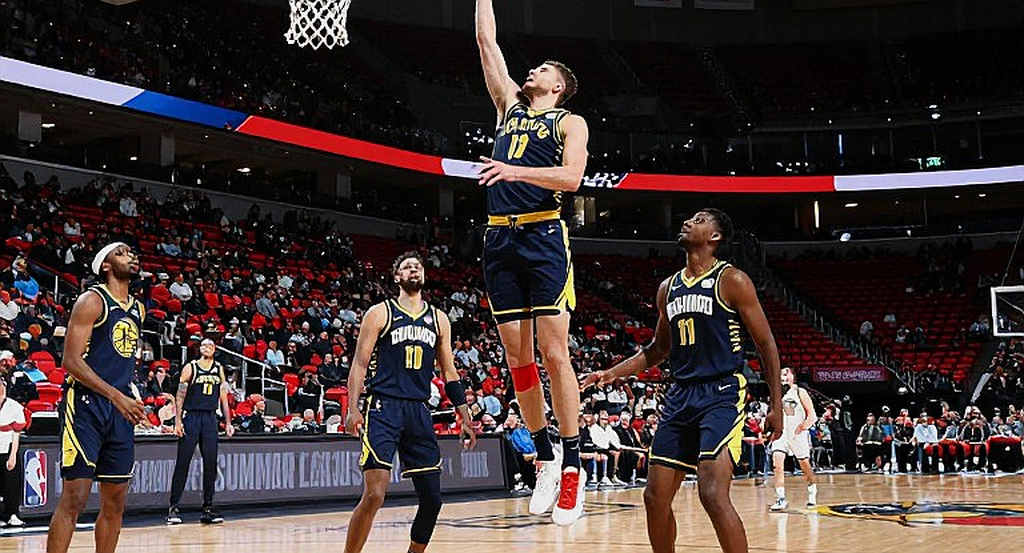
Cedi Osman scored 27. Marcus Foster scored 25, including 7 three-pointers. Together that is 52 of 100, more than half the team's offensive output coming from two men. In a game won by one point, that number carries existential weight: if either of them misses two more shots, PAOK loses.
I have written about teams like this elsewhere. They share a trait: they look wonderful on nights when those two pairs of hands are hot and entirely different on nights when they are cold. People call it primary-creator dependency. I call it an offensive architecture with a single load-bearing column.
More telling than the 25 points is its structure: 7 threes in one game place Foster in the group of players who score mainly from the perimeter, with little rim pressure and few free throws. This is the guard archetype that scores by moving off the ball and shooting on the catch, not the archetype that breaks a defence with physical pressure. In the regular season he will be treated the way perimeter players are always treated: chased over every screen, top-locked, forced to hold the ball in disadvantageous states.
Osman is different. At thirty-one, a wing who has played in the NBA is entering the last stretch of his physical prime. Still quick enough, still strong enough, but what is changing is the safety margin: an acceleration that was normal at twenty-five is now an expense. Twenty-seven points in a friendly is a positive signal about role. It is not a signal about regular-season form.
There is a small detail I cannot verify but cannot ignore. In a preseason friendly, a Greek club leaving its two primary scorers on the floor long enough to produce more than half its points suggests the coach is chasing chemistry, not testing depth. That is true professionally. It is also true commercially: people pay to watch those hands.
There is insufficient information to assess whether PAOK belongs to the EuroLeague 2026-27 field. The original article's loose phrase, several EuroLeague teams, is exactly that, loose. But if PAOK sits in the middle tier of the European pyramid, beating Partizan on a buzzer-beater is a signal worth tracking about volatility in the middle of the standings, provided we remember it is one game, one night, one time.
PARTIZAN: BALANCE WITHOUT A BLADE
On the other side, Partizan scored 99 and lost. Four players scored 18, 16, 14 and 13. A beautiful distribution. The kind of distribution any coach would draw on the whiteboard and call correct basketball.
But there is a kind of correct basketball that cannot win games decided in the final forty seconds. When the clock is under a minute, basketball stops being a system. It becomes a single question: who has the ball, and can that man manufacture a decent shot in seven seconds?
Partizan had no answer that night. Not for lack of talent. Because balance, compressed into one possession, becomes ambiguity. Five players who can all score means nobody is certain what to do in the last three seconds.
I have seen this pattern many times, in many sports. In athletics, it is the relay team with four good legs and no one owning their lane. In basketball, it is the team with half a dozen fifteen-point scorers that loses seven games a season to late-game hesitation.
Partizan led 99-95. Ball in hand. Clock running. Then possession changed, the buzzer sounded, and they lost.
The conclusion a friendly permits is narrow: they need an identified closing option. The conclusion it does not permit is that they have a mentality problem. One occurrence is not a sample. One occurrence is one occurrence. But in basketball, where a season is decided by three or four possessions, one occurrence is worth writing down.
I write it down: track Partizan's games decided by three points or fewer over the first ten rounds.
PANATHINAIKOS 90-69 AND THE TRAP OF DOMINANCE
Panathinaikos led 51-31 at halftime and finished 90-69 against JL Bourg. This is the kind of scoreline editors love, because it hands them an adjective. Commanding. Convincing. Classy.
But I was sitting in Athens looking at something else. JL Bourg is a EuroCup-tier club, not a EuroLeague-tier club. The gap between those tiers in Europe is wider than outsiders assume: roster depth, import quality, the ability to absorb two games a week. A EuroLeague side playing a EuroCup side in September, in front of fourteen thousand home fans, can win by twenty without playing well. The 90-69 says something about the distance between two competitions, not about Panathinaikos's form.
Two individual lines deserve more attention. Sylvain Francisco had 18 points, 5 rebounds and 5 assists. Mathias Lessort had 15 points and 7 rebounds. These are the lines I trust most in a preseason roundup, because they are not scorer's lines. They are participant's lines. A player with an 18-5-5 or a 15-7 is doing several things at once: scoring, rebounding, creating, screening, moving off the ball. That profile converts to regular-season value far more reliably than the profile of a man scoring 25 on seven threes.
At thirty-four, Lessort is at the stage where a centre can only compensate for physical decline with positioning. He still rebounds well, still stands in the right places. But the price of age in European basketball is not a drop in points, it is the number of minutes you can absorb. A thirty-four-year-old centre playing twenty-five minutes a night is normal. Playing thirty-two minutes a night in April is a gamble.

And above all those numbers sits a headline. The return of Obradovic. Zeljko Obradovic returning to the Telekom Center Athens, the arena bound to his name. An old stadium is like a thick manuscript; every season is a new marginal note.
But the original roundup devotes exactly one sentence to the event and never says which team he coached in the Panathinaikos-JL Bourg game. A missing detail, and it changes the whole story: if he returned as a Panathinaikos man, it is a homecoming. If he returned as an opponent, it is something else entirely, and the word emotional that the report attaches to it would weigh far more.
I leave the blank as a blank. A working writer should know where he does not know.
MOSCOW: A 42-32 GAP WIDENED INTO 100-76
Elsewhere, Anadolu Efes beat Zenit 100-76 in the VTB United League SuperCup. The first half ended 42-32. The game ended 100-76. The margin grew from ten to twenty-four after the break.
Twenty-four points in twenty minutes is not a shooting accident. It usually follows from one of two things: bench quality, or the conditioning collapse of a team that cannot hold a two-half pace.
Efes's scoring line that night was notable: Bruno Fernando 19 points and 8 rebounds. Mike James 13. Loyd 12. Dario Saric 12. A team with four men in double figures is a team with several independent offensive sources. That is a stronger structural signal than any individual line in this whole roundup, because it speaks about depth, and depth decides a thirty-eight-round season.
Bruno Fernando, twenty-eight, a centre returning from the NBA, posted 19 and 8 in limited minutes. The original calls him a former Partizan centre, and that small detail accidentally tells a bigger story: European basketball runs an internal market with no salary cap, where players move club to club between seasons as a form of de facto free agency. A centre from Partizan to Efes. A guard from the NBA to PAOK. That is a current, not news.
And Mike James, 13 points. I have to stop here and say something readers deserve to know: if this is the EuroLeague Mike James, born in 2026, then he is thirty-six and deep into the final stage of a peak career. If this is a different player with the same name, the entire analysis collapses. The original gives no birth date, no jersey number, no former club. I mark the data point as pending verification.
One more thing about Moscow, offered as a geopolitical aside from a man who watches from the margin: a EuroLeague club playing in a VTB United League event sits in an institutional grey zone. After 2026, Russian clubs were largely severed from the EuroLeague system. Efes's presence there says European basketball now exists in two parallel commercial blocs, and a September friendly in Moscow is a rare point of contact between them. No violation was reported. No sanction was mentioned. But the border on the scoreboard has moved, and few people write about it.
BELGRADE: 25 OUT OF 91, AND WHAT IS NOT SAID
Crvena Zvezda beat Aris. Jordan Nwora scored 25. Chima Moneke scored 15. If Zvezda's total was 91, Nwora accounted for more than a quarter of the team's offence.
This is the PAOK model again: a concentrated offensive architecture. At Zvezda it is less alarming because the Serbian club has a tradition of good depth and a stable defensive system underneath. But it remains a watch item: when a wing accounts for more than a quarter of the scoring, opposing defences begin building around him, and the question becomes whether the team has a second option once the first is locked.
And I must return to that crack in the glass. The original assigns Crvena Zvezda to Ibon Navarro. For an ordinary reader the detail passes by. For a working journalist it is a sign the roundup was assembled from several sources that nobody re-read. When a report gets a coach's name wrong, it can get a score wrong too.

That does not make this article meaningless. It makes this article narrower: I can speak about patterns, not about events.
THE AMERICANS COME HOME, AND THE PITCH IS NEVER STRAIGHT
Counting across all four games, the number of players with NBA experience is nearly enough to fill a lineup: Cedi Osman, Bruno Fernando, Dario Saric, Jordan Nwora, Loyd, Carlik Jones, and at least two more names appearing in scoring lines the original does not elaborate on.
This is a fact with industry value, and it sits in no paragraph of the original. European basketball remains a landing ground for the NBA's rotation-edge class: men with enough skill to play in the best league in the world but not enough slots to do it. They come to Europe at twenty-eight, thirty, thirty-two, and they become pillars of EuroLeague clubs.
But there is a technical detail anyone writing about this cohort must mention: FIBA rules differ from NBA rules. No defensive three seconds. A shorter three-point line. Different foul calls. Different travelling interpretations. A player who lived on the space created by the defensive three-second rule will find that space gone in Europe. A player who shot threes from 7.24 metres must relearn his feel at 6.75.
I have tracked this process for years, and it has never been a straight line. NBA-returning players in Europe typically need eight to fifteen games to find their rhythm, and during that window their data is the data of a man in transit, not a man playing. So Osman's 27 or Fernando's 19 and 8 in September should be read only as a small plus: they showed up, they participated, their bodies absorbed the pace.
At fifty-two, I understand the pitch is never straight; it bends to the patience of the man who stays. European clubs are patient with these players for about three months. After that, if they have not adapted, the press starts using the word disappointment, and the winter transfer market starts making calls.
THE CONTRARIAN ANGLE: SPECIALISATION OR VARIETY
There is a reading of the preseason week I want to place beside the conventional one.
The conventional reading says preseason tournaments are useful because they let teams test lineups and let fans see new faces. That reading is correct, but it ignores a reality: four games in three cities in four days is a significant volume of work before the season begins. Schedule density is the single biggest culprit behind injuries. No medical staff can save a player who plays two games a week in September, trains twice a day in October, and reaches March with intact ligaments. These friendlies are not merely a stage. They are a physical expense whose interest the season will pay.
And there is another thing about club-hosted preseason tournaments. An event named after a club's late president, staged in that club's arena, with that club in the final, in front of fourteen thousand paying spectators, is a commercial product. Its results are part of that product. This does not mean the players are not trying. It means we are not permitted to read those results as evidence of relative strength.
I have written something similar about football. When a coach switches to a back three after his back four is breached three games running, the media call it tactical innovation. Look closer and most of those switches are not progress. They are how a coach protects his reputation by changing the shape of the team rather than admitting the problem is in the personnel. A third centre adds a cover man to a weak defence and hands the coach an alibi: the system changed.
In basketball, the equivalent move is pushing a player into a new role during September friendlies. A guard tried off the ball. A centre tried at the three-point line. Sometimes that is genuine development. Sometimes it is a coach showing he did something over the summer.
The most frightening innovation does not begin with an explosion; it begins with a deliberate silence. And in September friendlies everything is loud: music, streamers, the PA. The frightening silence arrives in November, when the scoreboard stops being forgiving.
THE SKELETON OF THE ARENA
I have a habit my colleagues consider eccentric: after every big event, I vanish from the scrum and go looking for an empty seat.
In Athens I found one after the PAOK-Partizan game, as the stands began to empty and the rows slowly reappeared. Fifteen minutes earlier, that seat had a person in it. Fifteen minutes later, it was plastic and a dried smear of soft drink.
Without applause, an arena reveals its skeleton: the seats, the pitch, and the longing.
In March 2026 I hosted two games for a second-tier club in Shanghai, broadcast on a local cable channel. No spectators. Only the squeak of shoes on the floor and a coach's shouting filling a space that was far too large. The captain, thirty-four years old, tore a ligament in one of those games and announced his retirement right after. I sat alone in a room for three weeks, watching the tape back, like a cleansing ritual.
That is why I look at this week's four friendlies with a different eye. Fourteen thousand people in Athens is a handsome commercial number. But to me the more valuable thing is the moment after they leave, when the stand lights are still on and the scoreboard still glows 100-99. The arena never forgets. People do.
A FEW THINGS I WILL TRACK
From these four games I take five items to track over the first ten rounds.
PAOK's scoring balance: if Osman and Foster keep producing more than half the offence for five straight games, defences will lock them down and efficiency will fall.
Partizan's closing option: watch games decided by three points or fewer. If they lose three more of that kind before Christmas, pressure to sign a closer will surface before the winter window.
Obradovic's actual role: this needs confirmation from official sources, because it changes the entire story this week is telling.
Efes's depth: if second-half separation repeats in official games, it is a signal of a team competing from the bench.
The reliability of the original roundup: every data point in this article is unverified and there is at least one misattribution. Readers should cross-check club-level sources before quoting.
The transfer market is a chess game for those who know how to wait; the hasty usually buy with regret. European clubs are in a phase where every signal is inflated: a friendly becomes an indictment, a buzzer-beater becomes an identity. The patient will wait until November.
SPORT AS A COMMON LANGUAGE
I sat at Luzhniki in June 2026 and watched a twenty-two-year-old named Aleksandr Golovin run toward his coach and embrace him like a son finding his father. Golovin's gaze did not belong to the match; it belonged to the moment a boy suddenly became a man. I asked his coach afterwards, and he gave me a line I have carried for years: he is not a genius, he works in the dark.
That is what I look for at every sporting event, including a September friendly nobody will remember. Not the score. Not the box score. The moment a human being becomes another version of himself.
The four games in Athens, Moscow and Belgrade this week will be forgotten before Christmas. But one guard's hands shook when he caught the ball at 99-95. One player put the ball in the basket as the clock hit zero and did not have time to understand what had happened. Some Serbian kid in that arena that night will remember the moment for the rest of his life, and ten years later will tell a stranger that he was there.
That is sport's common language. It needs no translation. It only needs to be seen at the right moment.
As for the original roundup of those four games, I leave it on the desk with a note in the margin: unverified, contains errors, for reference only. A good sports writer is not the one who tells the most. A good sports writer is the one who knows where to stop and say he does not yet know.